Safe Drinking Water — Uranium & Manganese in Charlottetown’s Wellfields
Safe drinking water is the single most important responsibility of the City’s Water & Sewer Utility. Recent attention on uranium in the Miltonvale Wellfield and manganese in the Suffolk Wellfield shows this issue can no longer be treated as a future problem.
What is the Health Canada standard for uranium?
Health Canada’s maximum acceptable concentration for uranium in drinking water is 20 micrograms per litre (20 µg/L or 0.02 mg/L). The concern is not radioactivity. Uranium at elevated levels can affect kidney function over time, which is why the guideline exists.
What about manganese?
Some studies in humans suggest an association between manganese in drinking water and neurological effects in children. Because of this risk, the Guidelines for Canadian Drinking Water Quality recommend a maximum acceptable concentration (MAC) of 0.12 mg/L (120 micrograms per litre). In addition, an aesthetic objective of 0.02 mg/L (20 micrograms per litre) has been established because higher levels can cause discolouration of the water.
What do we know about Charlottetown’s wells?
The City has four wellfields. Miltonvale is the largest. The City has confirmed the need to address uranium at Miltonvale and manganese at Suffolk. A preliminary engineering design process for treatment options is now underway, with a report expected by the end of 2026.
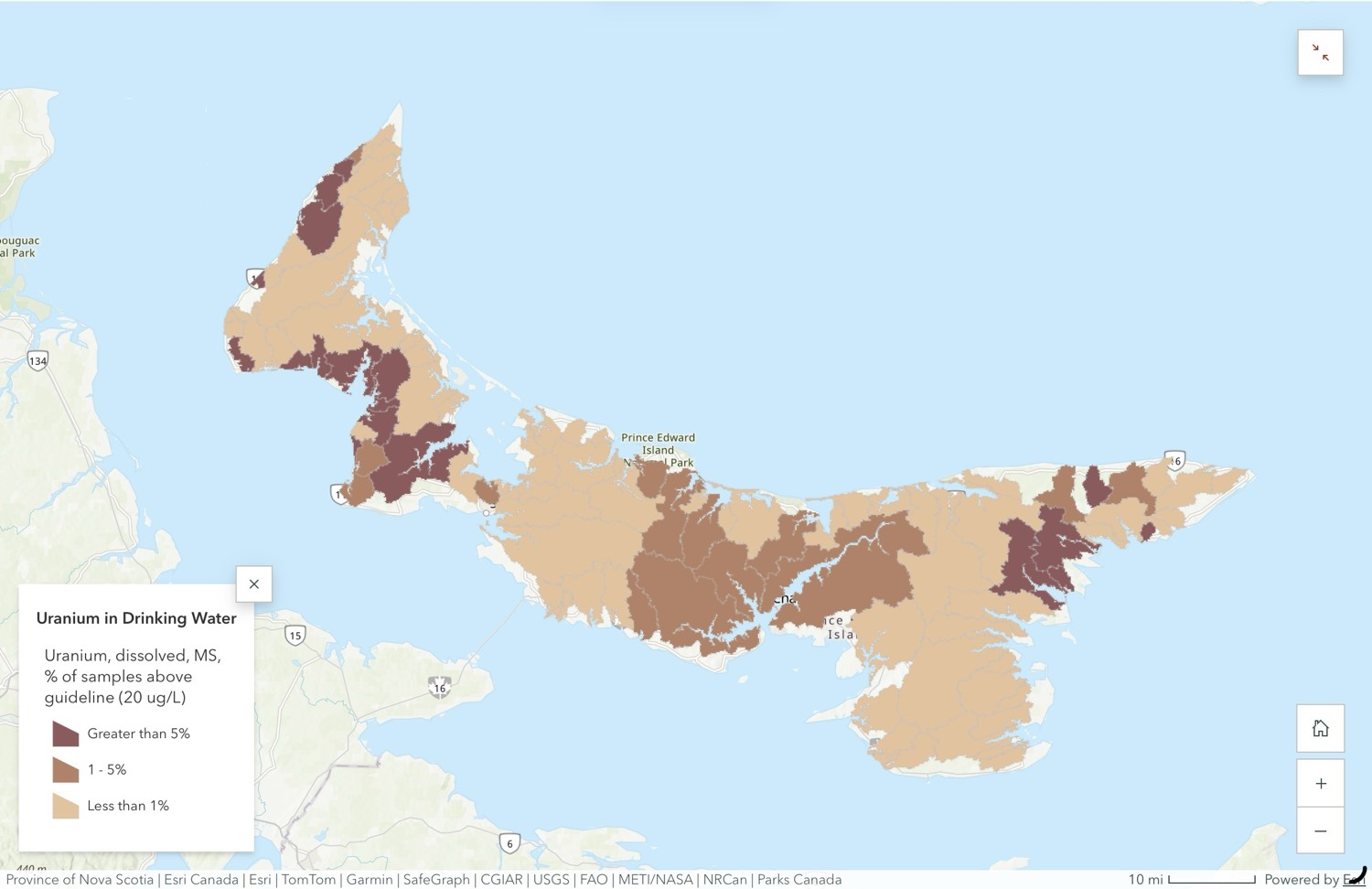
Map showing percentage of samples above the uranium guideline (20 µg/L) by watershed.
Courtesy of the Government of Prince Edward Island.
Can the water simply be blended?
One possible approach is blending water from higher-uranium wells with water from lower-uranium wells. However, until the City releases specific data for each individual well at Miltonvale, it is not possible to know whether blending with existing wells will be sufficient.
What about treatment options?
If additional processing is required, some conventional options may be limited. The Miltonvale site is a significant distance from the Pollution Control Plant, which would need to handle any treatment effluent. This distance can restrict certain treatment methods.
Another approach involves specialized filtering materials. Depending on the concentration of uranium captured, these materials can require special handling and disposal.
Why does this matter for City spending?
Proper treatment will carry both capital and ongoing operating costs. Before the City commits large amounts of money to other major projects — including further work on Spencer Drive — residents and Council deserve a clear understanding of the full cost of making the drinking water supply safe.
What should happen next?
- Complete the current preliminary engineering design.
- Release well-specific data so realistic options (including blending) can be properly assessed.
- Present capital and lifecycle cost estimates for the necessary treatment.
- Only after those costs are understood should major new infrastructure commitments proceed.
Clean, safe water is not optional. It is the foundation everything else rests on.
Click here to learn more about water quality challenges in Prince Edward Island